


If you’ve asked for a website quote and received wildly different numbers, you’re not alone. One proposal may cover a few basic pages; another may include custom design, writing, search setup, and ongoing support. Both can be called “a business website,” but they’re not necessarily the same project.
So what should you budget for affordable web design NJ? The honest answer is that there’s no single statewide price, and no one can give you an accurate quote without understanding what your business needs. But you can get a useful sense of the range, what affects it, and how to compare proposals without feeling pressured.
First, what does “affordable” really mean?
Affordable doesn’t always mean the lowest price. It means getting the right scope for your budget, with a clear understanding of what’s included and what you’ll pay for later.
A low quote could be a good fit if you need a simple, limited-scope website. It could also leave out writing, revisions, mobile adjustments, or support. A larger quote may reflect more work, but it’s fair to ask what that work is and whether it matters for your goals.
The useful question isn’t just “How much?” It’s “What am I getting for that amount, and what will I still need?”
A practical guide to website price ranges
There’s no official New Jersey rate card for small-business websites. Published state pricing guides, the kind agencies and freelancers share publicly, tend to land in similar territory. Treat these as planning guideposts, not a statewide survey:
- A basic, template-based brochure site often starts around $500 and runs to about $2,500. Good for a business that needs a straightforward online introduction.
- A more customized small-business site, several pages with considered design and room to grow, commonly sits in the $3,000 to $5,000 band.
- Bigger builds with multiple services, locations, or a fuller content structure usually range from $7,000 to $12,000.
- E-commerce and custom functionality often start around $10,000 and go up from there.
These are broad guideposts, not a promise of what your project will cost. Page count, content, design animations, hosting, domain, emails, maintenance, and functionality move the number a lot, and every published range is a starting point for questions rather than a guaranteed price for your business.
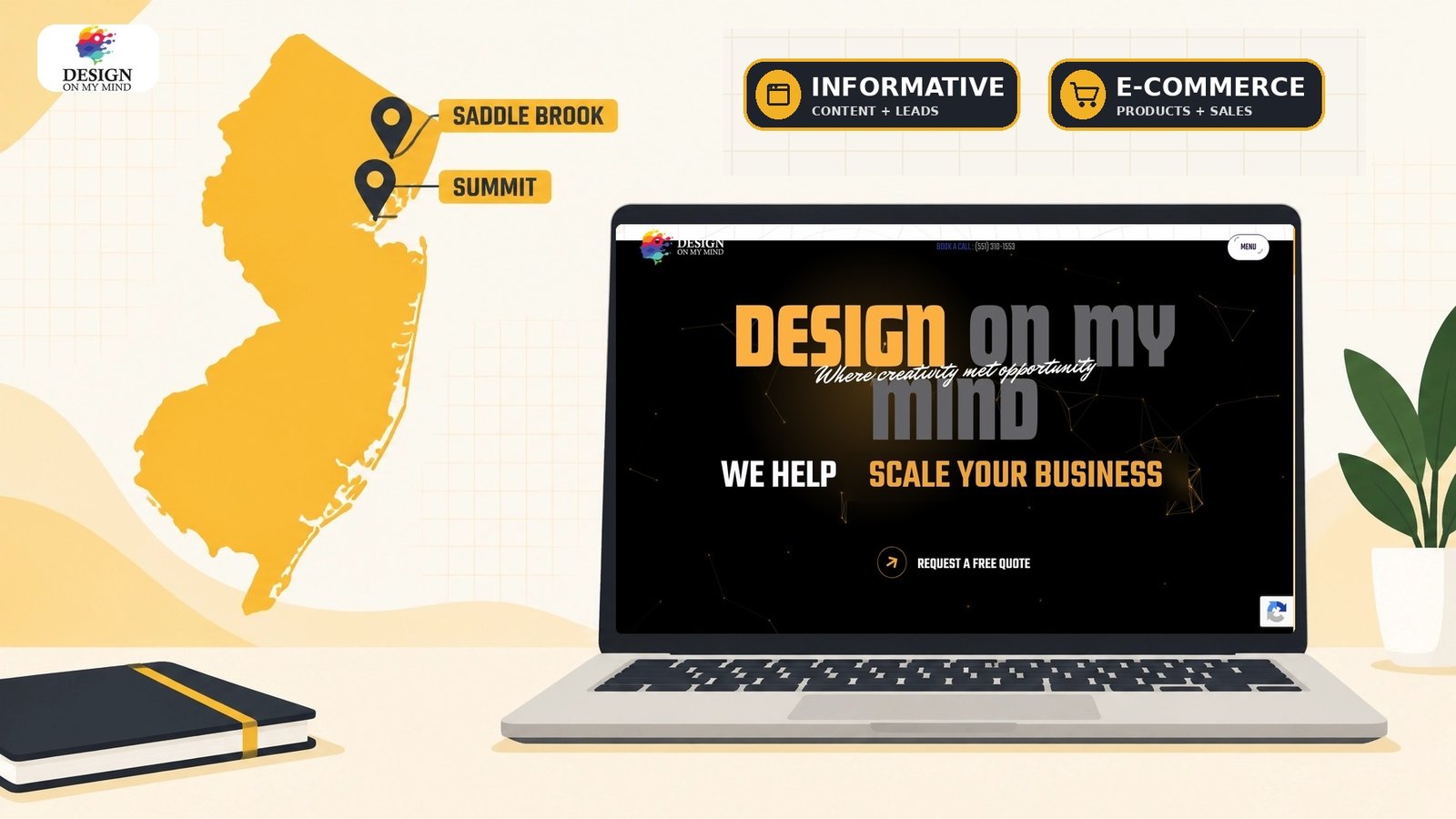
There are also smaller, fixed-scope offers in the market, and these are where a lot of first-time founders actually start. Design On My Mind’s web development page lists published packages from $299 for a one-page refresh up through $1,249 for a site of up to ten pages. Those prices describe specific offerings and inclusions, they aren’t a quote for every custom project. If you’re comparing website design in Summit, NJ or anywhere else in the state, compare the actual work in each proposal, not just the headline number.
One honest note on that gap: a $299 page and a $12,000 build aren’t competing products, so don’t expect the cheap one to behave like the expensive one. The useful comparison is against your own goal. If you need a credible place online that answers “who are you, what do you do, how do I reach you,” a focused package does that job. If you need to rank across several towns and service lines, that’s a bigger project, and it should be priced like one.

What changes the price?
You don’t need to know technical terms to understand a quote. Focus on the decisions that change how much work the project involves.

The number and purpose of your pages
A small site with a home page, services, about, and contact information is a different undertaking from a site with separate pages for each service, town, or audience. More pages usually mean more writing, design, review, and testing.
Start with what a potential customer needs to know to take the next step. You can add pages later when you have a clear reason for them.
Design that fits your business
A ready-made layout adapted with your colors and content can keep a project focused. A more customize design may take additional planning and revisions, especially if your business needs a distinctive look or has a lot of content to organize.
Neither choice is automatically better. The right one depends on how much customization your business needs and what fits your budget.
Who supplies the words and images?
Some projects assume you’ll provide final, approved copy and photos. Others include help writing content, selecting stock images, or organizing material from an older site. Confirm this before work begins: “content included” can mean different things to different providers.
If you’re able to supply clear copy and good-quality photos, that may keep the project simpler. If you need help, it’s reasonable to ask for that support to be listed as a separate item.
Features beyond the basics
A contact form is different from an appointment booking system, online payments, a product catalog, or a connection to other business software. Each feature needs to be set up and checked. If you don’t need a feature on day one, you can ask whether it can be added later.
What happens after launch?
The initial build and the ongoing cost of running and deploying a website are not always the same thing. Ask whether your proposal includes hosting, domain renewal, maintenance, updates, backups, security checks, SSL certificates or help with changes after launch. The hosting service page explains Design On My Mind’s hosting options; make sure you understand which services apply to your specific plan.
Cheap and affordable are not the same
A low-cost offer may be a perfectly reasonable choice if its limits match your needs. It becomes a concern when you assume it includes services that were never part of the agreement.
Before you agree, ask for clear answers to these questions:
- How many pages are included?
- Who writes and adds the text and images?
- How many rounds of changes can I request?
- Does the site work well on phones?
- Are forms or other features included?
- Who owns the website and domain?
- Is hosting included? If so, for how long?
- Is ongoing support included, and what does it cover?
A provider should be comfortable explaining the answers in plain English. You shouldn’t need to feel embarrassed for asking. If a proposal is confusing, request an itemized version and time to review it.
A simple way to set your budget
Before requesting quotes, write down three things: what your website must do at launch, what you can comfortably invest, and what can wait.
For example, a local service business may need a clear home page, a few service details, a contact form, and reliable mobile display. A business that sells products may need a store, payments, and product information too. Those are different scopes, and your quote should reflect the one you actually need.
Then ask for estimates based on the same outline. You’ll be able to compare providers more fairly and spot what each one includes. If the numbers still vary, ask each provider to explain the difference. A good web design agency should be able to walk you through the scope patiently, without pushing you into features you don’t need.

Get a clear quote, without the pressure
Your website should support your business, not leave you wondering what you agreed to or what the next bill will be. A thoughtful budget starts with a clear scope, a transparent proposal, and a provider who makes the process comfortable to discuss.
At Design On My Mind, we guide entrepreneurs and small-business owners step by step, including people building their first website. If you’re ready to explore what your project may involve, request a quote. Tell us a little about your business, what you want your site to do, and your budget if you have one. We’ll help you understand the options.